
At this point, we’ve all heard the terms ‘analog’ and ‘digital’ tossed around, but do we really understand what they mean, and why the idea of ‘digital’ has become widely popular in the last few decades?
First, let’s briefly define each term. Analog refers to a form of communication that is continuous and non-measurable, such as the sound waves of somebody’s voice, or the fluent movement in dance. This form of communication is unique every single time it is used: meaning that no two analog messages are the same, and even though you can come close, they cannot be replicated. On the other hand, digital communication uses distinct integers to share ideas, such as a defined number of letters in an alphabet, or sound waves being converted into binary codes that can be transmitted and duplicated. This form of communication is much more compatible with technology because it is easy to distinguish, which is what we’re going to dive into.
When it comes to transmitting signals, one of the largest issues is the idea of noise, which is a form of interferance that can make it difficult to tell exactly what the signal is saying. In the simplest form, you may hear noise over an FM radio when driving through a heavily wooded area, as the trees might be blocking the signal from coming through as clearly as it could in an open area. When analog signals experience noise, they are sometimes misinterpreted by the receiver, because the signal didn’t come through in a clear manner. Because analog signals are on a continuum, it is very difficult to distinguish a 2.3 from a 2.4, for example, if there is noise involved. The receiver may pick up a 2.35, which it then is faced with the challenge of guessing what it should output. In a real-life setting, imagine you are listening to a quiet radio with some interference. Instead of hearing the lyrics clearly, you hear something in between and fill in the spots to the best of your knowledge. Analog signals can work in a similar way.
But digital communication handles noise differently. While digital signals are still fully susceptible to noise, intervals (specifically, ones and zeros) are much easier to distinguish from one another, even if the signal isn’t clear. To break it down, let’s look at an example of a digital amplifier that uses six electrons to receive signals. If the amplifier receives six electrons, it will perceive the message as a ‘one’. In the image to the right, you can see that the input signal going into the digital amplifier isn’t clear – it is experiencing noise.
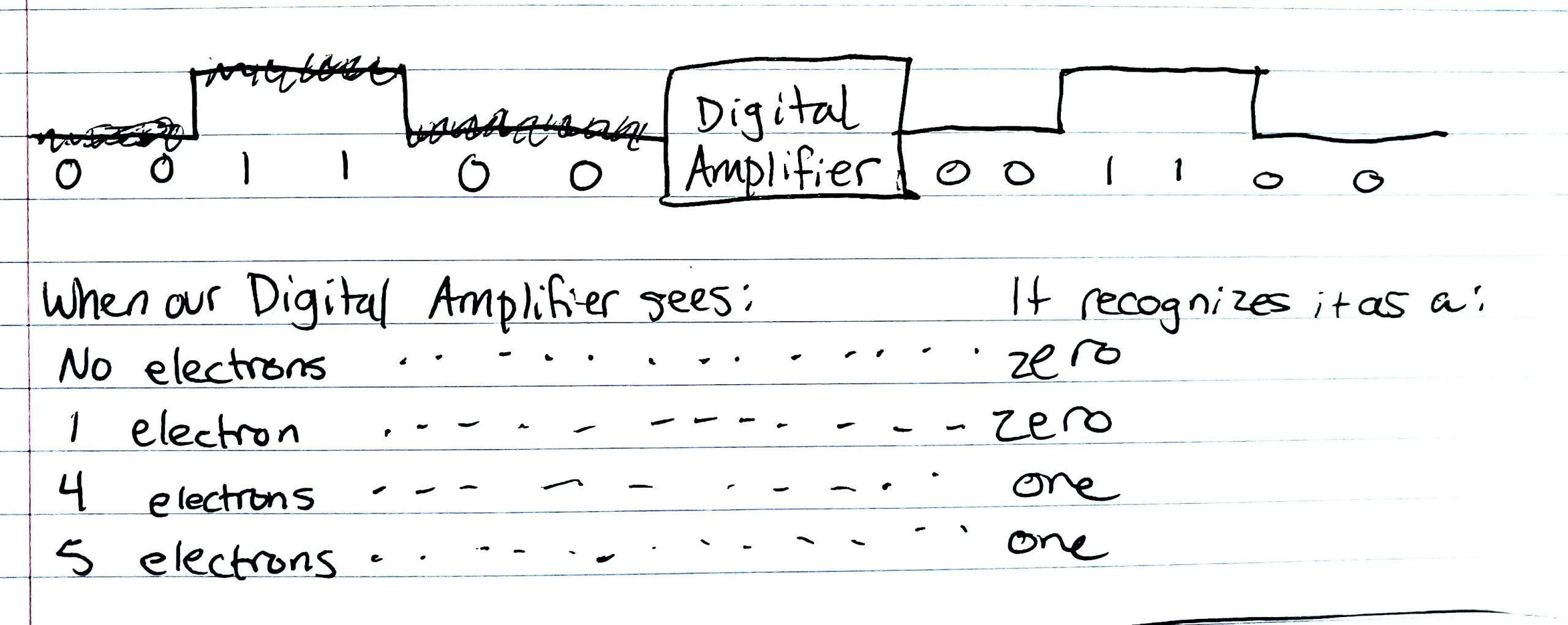
However, the digital amplifier has the ability to distinguish between a one and zero, which means that any signal with four, five, or six electrons will be perceived as a ‘one’, and any signal with three electrons or less will be perceived as a ‘zero’. And because this noise is easily perceived in a simple one-or-zero fashion by the digital amplifier, it then outputs a signal that eliminates the noise. Therefore, it is much easier to transmit clear, understandable signals between devices, and to share information that experiences less disruption from noise. This very idea is the magic of digital, and it has revolutionized our technology, as we can now communicate in clear and concise ways across devices of all sorts, who perceive the digital signals in the same way as one another.